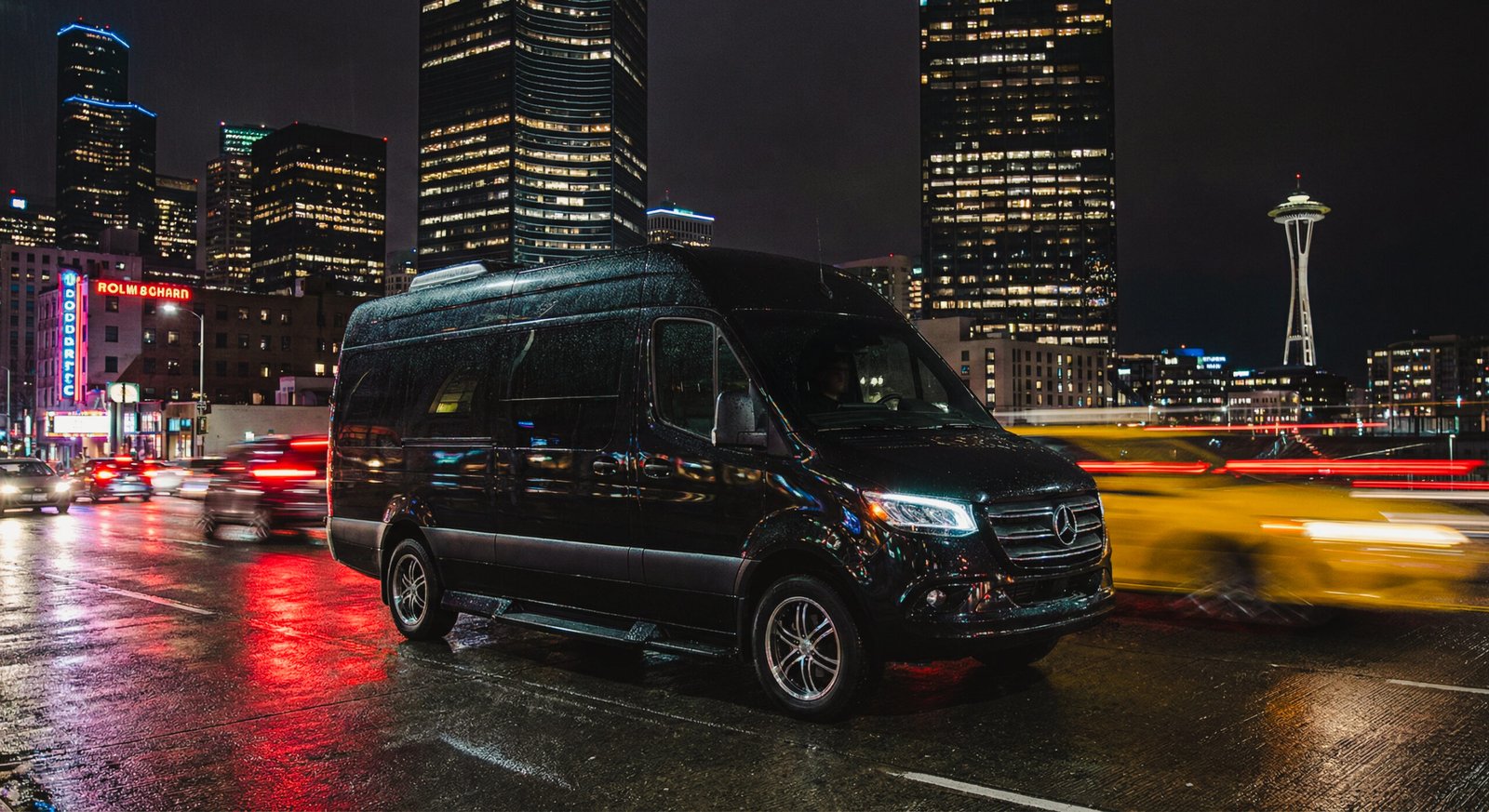
You have landed at Seattle-Tacoma International and you need to get downtown. There are four realistic ways to do it, and the honest answer is that the best one depends entirely on how many of you there are, how much you are carrying, and what time it is.
Here is the whole picture, including the options we do not sell.
The four options at a glance
Option | Time downtown | Cost | Luggage | Best for |
Link light rail (1 Line) | About 38 min to Westlake | $3 adult, each way | Carry it yourself, no dedicated space | Solo and duo travellers, light packers, downtown hotels |
Taxi | 25–45 min, traffic dependent | Typical fare | Boot space for 2–3 bags | Short queues, no app, straightforward trips |
Rideshare | 25–45 min, traffic dependent | Variable, surges at peak | Depends on the car that arrives | Flexible budgets, off-peak arrivals |
Private car service | 25–45 min, traffic dependent | Fixed, quoted in advance | Sized to your booking | Groups, heavy luggage, late arrivals, business travel |
Link light rail: the cheapest option, and often the right one
Sound Transit’s 1 Line runs from SeaTac/Airport Station into downtown Seattle, reaching Westlake in about 38 minutes for a $3 adult fare. Trains run roughly every 8 to 15 minutes depending on the time of day, and because the line is grade-separated from traffic for most of its length, that 38 minutes is 38 minutes whether or not I-5 is a car park.
That predictability is the real argument for it. A taxi can beat the train at ten on a Sunday morning; nothing beats it at five on a Thursday afternoon.
Getting to the station
The station is not attached to the terminal. From baggage claim you head up to the fourth floor, cross the skybridge into the parking garage, and follow the signs — a walk of roughly seven to nine minutes. There is a free shuttle between the skybridge and the station if you would rather not walk it.
Where it falls down
- Luggage. There are no dedicated racks. You stand with your bags, and at peak times you stand with your bags in a crowded carriage.
- It does not go everywhere. Westlake, Pioneer Square, University Street and the stadium district are well served. Queen Anne, Ballard, Fremont, Magnolia and the cruise terminals are not, and you will be paying for a second leg.
- Hours. Service runs roughly 5am to 1am. Outside that window there is a night bus, but if you land at 1.30am with a family this is not your option.
- Groups. Three dollars each is excellent value for two people. For six people with luggage the maths changes, and so does the experience.
Verdict: if you are travelling light, going somewhere the train actually goes, and arriving during service hours, take the train. It is genuinely good and we are not going to pretend otherwise.
Taxi
Taxis queue at the designated airport stand and require no app, no account, and no advance booking. For a straightforward downtown run with two people and normal luggage, that simplicity has real value.
The limitations are the ones taxis have everywhere: you take the vehicle at the front of the queue, whatever it is, and the meter runs while you sit in traffic. There is no flight tracking, so a delayed arrival simply means a longer queue at a stranger hour.
Rideshare
Uber and Lyft operate from a designated pickup area at the airport rather than kerbside at arrivals, so budget a few minutes to walk to it.
Rideshare is often the cheapest door-to-door option off-peak and one of the most expensive during surge. That is the trade: you are buying a price that is set at the moment you request the car, and the moment you request the car is the moment when everyone else on your flight is also requesting one. Late-night arrivals, holiday weekends, and any evening when a delayed widebody unloads all at once are exactly when the number is highest.
It is a good option if your plans are loose and your budget is flexible. It is a poor option if you need certainty.
Private car service
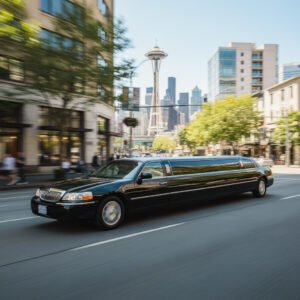
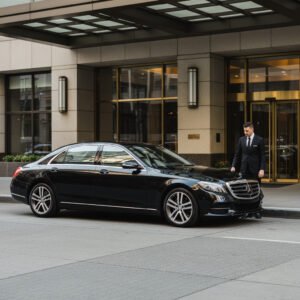
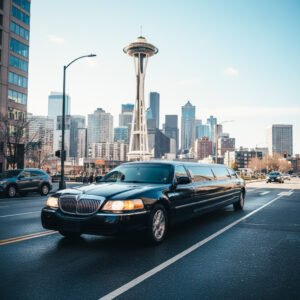
A chauffeured transfer is quoted and fixed before you fly. The chauffeur tracks your flight number, so a delay moves the pickup automatically, and the vehicle is sized to your group and luggage rather than to whatever happens to be available.
The full detail on how the pickup works — where you meet, how the name sign works, how wait time is handled — is in our guide to meeting your chauffeur at Sea-Tac.
Where it clearly wins:
- Groups of four or more. The per-person cost converges fast, and everyone stays together. See the capacity guide.
- Heavy or awkward luggage — ski gear, golf clubs, instruments, trade show equipment.
- Late-night and early-morning flights, when the train is not running and rideshare pricing is at its worst.
- Business travel, where a delayed executive standing in a rideshare queue is a more expensive problem than the transfer.
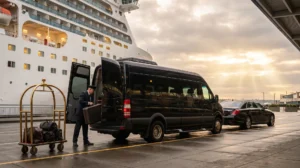
- Cruise transfers, which the train does not serve at all.
Pricing is explained in full in how much does a limo cost in Seattle.
So which should you take?
- Solo or a couple, light bags, downtown hotel, daytime arrival — light rail.
- Two or three people, moderate luggage, no strong preference — taxi or rideshare, whichever queue is shorter.
- Four or more people, or significant luggage — private car. The maths stops favouring anything else.
- Arriving after midnight or before 5am — private car, booked in advance.
- Going to a cruise terminal, Bellevue, Ballard, Queen Anne or anywhere the train does not reach — private car, unless you are happy paying for two legs.
- Business travel on someone else’s clock — private car.
Seattle traffic, honestly
Anything on wheels is subject to I-5 and SR 518, and both are unpredictable in ways that surprise visitors. The afternoon peak starts earlier than people expect and lasts longer. Event days at Lumen Field and T-Mobile Park distort everything south of downtown. Any of the three road options can take 25 minutes or 55 minutes on the same route on different days.
Budget accordingly, particularly on the outbound leg where a missed flight is the failure mode.
Book a fixed-price transfer
If the train is right for your trip, take the train. If it is not, book an airport transfer and we will track your flight and quote the fare before you fly. Get a quote.