Seattle is one of the main departure ports for Alaska, and it has a quirk that catches people out every single season: there are two cruise terminals, they are miles apart, and they serve different cruise lines.
Arriving at the wrong one with luggage and ninety minutes to sailing is the most expensive mistake available on embarkation day. Here is how to avoid it, and everything else about getting to your ship.
Step one: confirm your pier
Before you book a hotel, a car, or anything else, open your cruise documents and find the terminal name. Not the city — the terminal.
Terminal | Where it is | Lines sailing from it in 2026 |
Pier 91 — Smith Cove Cruise Terminal | 2001 W Garfield St, Interbay — about 3 miles north of downtown | Holland America, Princess, Royal Caribbean, Carnival, Celebrity, MSC, Virgin Voyages, and Cunard on selected dates |
Pier 66 — Bell Street Cruise Terminal | 2225 Alaskan Way, on the downtown waterfront | Norwegian, Oceania, and Cunard on selected dates |
Cunard is the one to watch: Queen Elizabeth alternates between the two piers depending on the sailing date. Do not assume based on the line alone.
Pier 91 versus Pier 66: what actually differs
Pier 91 (Smith Cove) is the larger operation and handles most of the fleet. It sits in Interbay, an industrial pocket north of downtown, which means excellent vehicle access, generous parking and staging, and a cell phone lot — but essentially nothing within walking distance. You arrive, you board. There is no wandering off for lunch.
Pier 66 (Bell Street) is on the downtown waterfront, walkable to Pike Place Market and a large stock of hotels. The trade-off is access: Alaskan Way gets tight on mornings when several ships turn around at once, and the surrounding area has been through years of waterfront construction.
Getting there from Sea-Tac
The piers are roughly 17 miles from the airport. Allow 30 to 40 minutes in light traffic and considerably more in the afternoon peak. Your options:
Cruise line motorcoach transfer
Sold by the cruise line, usually priced per person. Convenient, and reasonable value for a couple. For a family or a group of six it becomes one of the more expensive ways to travel, and it runs on the coach’s schedule rather than yours.
Taxi or rideshare
Workable, with the usual caveats. Embarkation mornings concentrate demand into a narrow window, which is precisely when rideshare pricing is least friendly, and a standard car may not swallow a family’s cruise luggage.
Link light rail
Does not serve either pier. You would ride to Westlake and then take a second, separate ride to the terminal. Practical for a couple travelling light and going to Pier 66; awkward for anyone else, and genuinely difficult with full cruise luggage. See our full Sea-Tac to downtown comparison.
Private car transfer
Quoted in advance, sized to your party and luggage, with the flight tracked so a delayed inbound does not become a missed sailing. For groups this is usually both cheaper than per-person motorcoach seats and considerably less stressful. Request one through the seaport quote form.
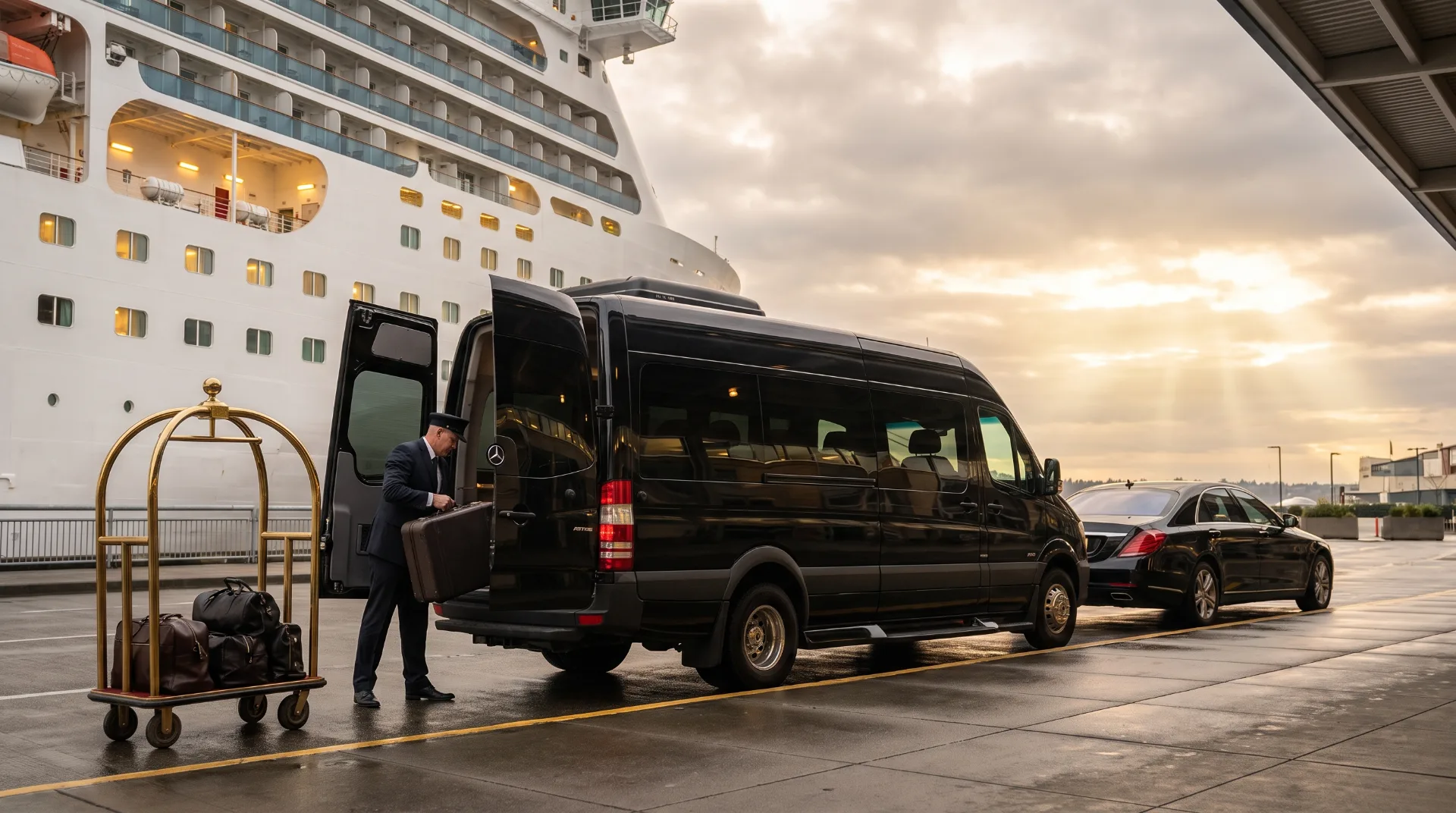
Group sizes and luggage capacity are covered in the capacity guide. Cruise parties almost always want the luxury Sprinter van — cruise luggage is bulkier than airline luggage and the van is built for it.
The single best piece of cruise advice
Fly in the day before.
Alaska sailings leave on schedule, and a same-day flight puts your entire holiday behind one delayed aircraft. A pre-cruise hotel night removes the only genuinely catastrophic risk in the whole trip, and it means you board rested rather than sprinting.
If you do fly in the day before, look at hotel location in relation to your pier rather than to “Seattle” generally. Downtown works well for Pier 66 and is walkable. For Pier 91 you are getting a car either way, so choose the hotel you actually want.
Embarkation day timing
- Check your assigned boarding window. Cruise lines stagger arrivals and turning up hours early no longer helps.
- Allow 30 to 40 minutes from the airport, more between about 3pm and 6pm.
- Hand your bags to the porters at the kerb. Keep passports, medication, and anything you need in the first few hours with you — checked bags can take hours to reach your cabin.
- Build in a buffer. Not because your driver will be late, but because embarkation mornings at Pier 66 in particular can back up on Alaskan Way.
Coming home: Port Valet
Seattle offers a hands-free luggage service that is genuinely one of the best perks in North American cruising. On the last night of the sailing your bags are collected from the cabin, checked in for your flight, and sent through to the baggage claim at your final destination. You spend disembarkation morning with nothing but a day bag.
Eligibility depends on your cruise line and your airline, so check aboard early in the sailing. If it applies to you, take it.
It also changes what you need from your transfer home. A party of six with no luggage has very different vehicle requirements than the same party arriving.
Disembarkation morning
Ships clear early and the terminal empties fast, which produces a large number of people wanting cars at the same moment. A pre-booked transfer with a known pickup point is worth more here than at any other stage of the trip.
If your flight is not until the evening — common on Alaska returns — you have most of a day in Seattle. An hourly booking that stores your luggage and takes in Pike Place, the Chihuly garden, or Discovery Park beats sitting in an airport for seven hours. See hourly rates.
Book your cruise transfer
Tell us your pier, your party size, and your flight, and we will handle the rest. Get a quote.
Looking for prices? Our Seattle cruise port transportation page carries the full rate table for Pier 91 and Pier 66 — from Sea-Tac, downtown hotels, the Eastside and Tacoma — along with vehicle sizing for cruise luggage.
Terminal-specific detail lives on its own page for each pier: Pier 91 (Smith Cove) cruise terminal transportation covers the Magnolia approach and the single access road that backs up on turnaround Saturdays, while Pier 66 (Bell Street) cruise terminal transportation covers the tighter downtown kerb and the Alaskan Way traffic pattern.